Unit 1. Introduction. Information sources
Pablo Sánchez-Núñez
Unit 1. Introduction. Information sources
Digital Skills for Information Use
https://pablosancheznunez.com/digital-skills-information/01-sources.html
Objectives
- Recognise information overload and the different types of false information.
- Use digital information critically, reflectively and proactively.
- Identify, select and evaluate information sources, including social media as a scientific source.
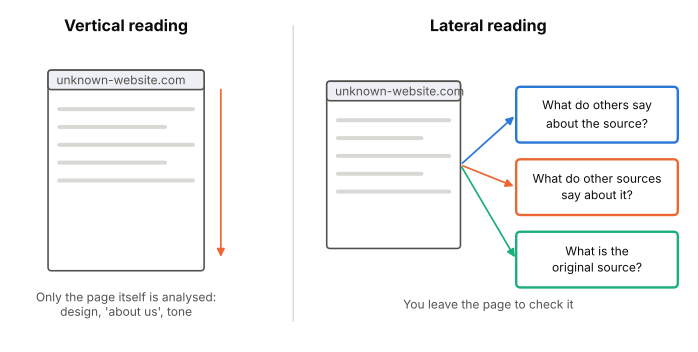
Vertical versus lateral reading
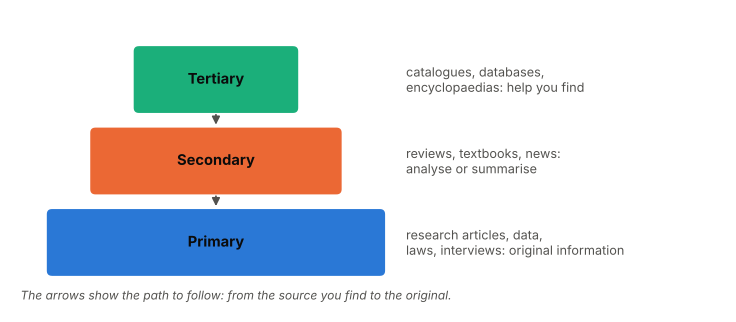
Types of sources
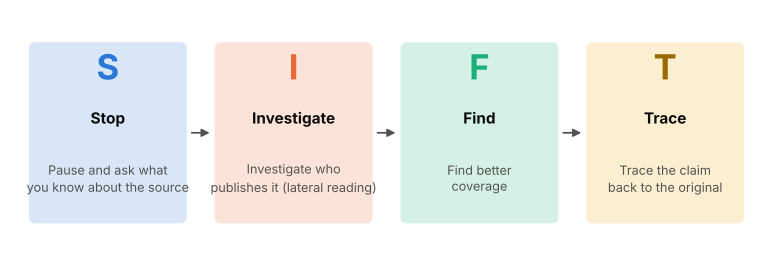
The four moves of the SIFT method for evaluating online information
Information, overload and false information
| Type | What it is | Example |
|---|---|---|
| Misinformation | False, but shared without intending to deceive | Forwarding an ineffective home remedy believing it works |
| Disinformation | False and created or spread to deceive | A campaign with invented data to influence an election |
| Malinformation | True, but used to cause harm | Publishing someone’s real personal data |
Identifying, selecting and evaluating sources
| Criterion | Questions |
|---|---|
| Authorship | Who signs it? Do they know the subject? Is there a responsible organisation? |
| Purpose | Does it inform, give an opinion, sell, persuade? |
| Currency | When was it published or updated? Does the date matter for your topic? |
| Accuracy | Does it cite its sources? Can it be checked? Does it agree with other reliable sources? |
| Review | Has it passed peer review, professional editing or no check at all? |
Further resources
| Resource | What it is for |
|---|---|
| IFLA – How to Spot Fake News (2017) | Eight-step infographic for spotting fake news, in many languages |
| Caulfield, M. – SIFT (The four moves) | The SIFT method explained by its author |
| ACRL – Framework for Information Literacy | Framework for information literacy |
| Full Fact, Maldita.es and Newtral | Fact-checkers in the UK and Spain |
| IFCN – Code of principles | International fact-checking network |
| The information literacy user’s guide | Open textbook from the core bibliography |
Required reading
Metzger, M. J.; Flanagin, A. J. (2013). Credibility and trust of information in online environments: The use of cognitive heuristics. Journal of Pragmatics, 59, 210-220.
For discussion
- Forwarding an ineffective home remedy believing it works is a case of disinformation / misinformation / malinformation
- According to Pennycook and Rand, many people share fake news mainly through a lack of ______
- Lateral reading consists of analysing the page itself in depth before leaving it. (true or false?)
- The last SIFT step, tracing to the original, looks for the tertiary / primary / secondary source
For discussion
- Which heuristic do we use when we trust a website because it has many positive reviews? Reputation / Endorsement / Persuasive intent
- A review article summarising many studies is a primary / secondary / tertiary source
- What do social media mentions of an article measure?
- Spreading someone’s real personal data to harm them is misinformation / disinformation / malinformation
For discussion
- A law published in the Spanish Official State Gazette (BOE) is a primary / secondary / tertiary source
- A preprint has already passed peer review. (true or false?)
Digital Skills for Information Use