Unit 2. Information retrieval
Pablo Sánchez-Núñez
Unit 2. Information retrieval
Digital Skills for Information Use
https://pablosancheznunez.com/digital-skills-information/02-retrieval.html
Objectives
- Apply the principles and strategies of information retrieval.
- Use general and specialised resource platforms.
- Organise the information you find.
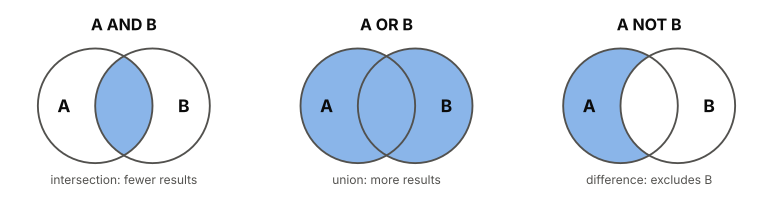
Boolean operators as sets
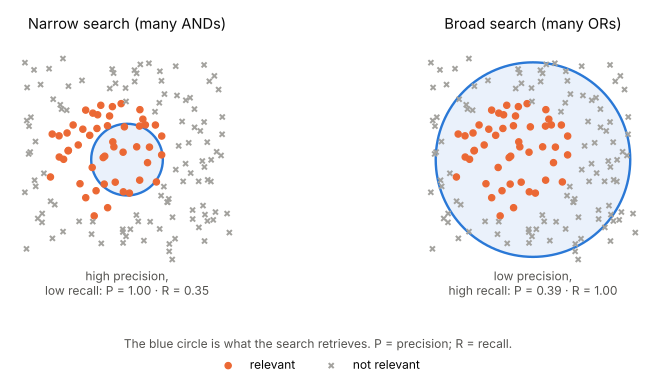
Precision and recall with the same documents
Operators and techniques
| Technique | What it does | Example |
|---|---|---|
| AND | All the terms: reduces results | mobile AND performance |
| OR | Any of the terms: broadens (synonyms) | mobile OR smartphone |
| NOT | Excludes a term | performance NOT sports |
| Parentheses | Group and order the operations | (mobile OR smartphone) AND performance |
| Quotation marks | Exact phrase | "academic performance" |
| Truncation | Variants of a stem | universit* finds university, universities… |
| Field searching | Only in title, author, abstract… | title:(smartphone) depending on the platform |
General and specialised platforms
| Type | Examples | What for |
|---|---|---|
| General search engines | Google, Bing | General information, institutional websites, news |
| Academic search engines | Google Scholar, BASE, OpenAlex | Scientific literature in all fields |
| Library catalogues | UC3M library catalogue | Books and resources subscribed to by the university |
| Multidisciplinary databases | Web of Science, Scopus (with university access), Dialnet | Peer-reviewed articles, with filters and controlled vocabulary; Dialnet for literature in Spanish |
| Specialised databases | PubMed (biomedicine), ERIC (education), LISTA (library science) | Comprehensive searching in one field |
| Repositories | Recolecta, institutional repositories | Open access versions |
Example 1 · From the question to the search string
| Concept | Terms |
|---|---|
| Mobile phone | smartphone*, “mobile phone”, ”cell phone” |
| Academic performance | “academic performance”, “academic achievement”, grades |
| University students | universit, “higher education”, “college student” |
Required reading
Bates, M. J. (1989). The design of browsing and berrypicking techniques for the online search interface. Online Review, 13(5), 407-424.
For discussion
- To broaden a search with synonyms you use the operator AND / OR / NOT
universit*is an example of ______- Adding concepts with AND usually increases precision and reduces recall. (true or false?)
- According to Bates, real searching is a single query that returns the perfect set of documents. (true or false?)
For discussion
- If I find 20 documents and 5 are useful, precision is 0.20 / 0.25 / 0.50 / 4
- What are quotation marks used for in a search?
- To search the biomedical literature comprehensively, the most suitable platform is a general search engine / PubMed / an institutional repository
- The proportion of all relevant documents that a search retrieves is its precision / recall / relevance
For discussion
- A thesaurus is an example of a ______ vocabulary
- In
(mobile OR smartphone) AND performance, the parentheses make OR be resolved before AND. (true or false?)
Digital Skills for Information Use