Unit 3. Ethical use of information and plagiarism
Pablo Sánchez-Núñez
Unit 3. Ethical use of information and plagiarism
Digital Skills for Information Use
https://pablosancheznunez.com/digital-skills-information/03-ethics-plagiarism.html
Objectives
- Know the basics of intellectual property and the right of quotation.
- Recognise the different types of plagiarism.
- Produce academic work without plagiarism: quote, paraphrase and summarise correctly.
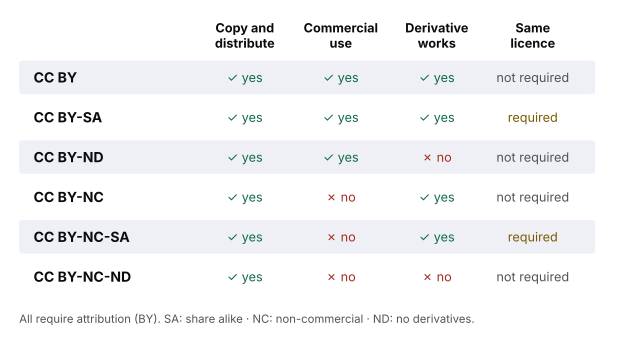
What each Creative Commons licence allows
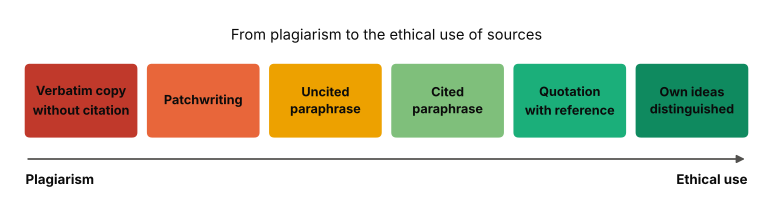
From plagiarism to ethical use: what changes is not the words, but whether you acknowledge the source
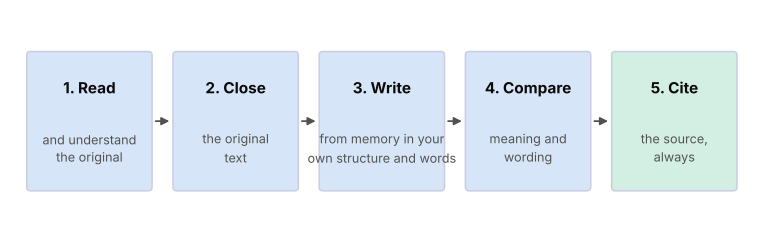
Five steps to paraphrase without plagiarising
What plagiarism is
| Type | What it is |
|---|---|
| Verbatim copying | Copying text without quotation marks or citation |
| Patchwriting | Copying while changing a few words or their order, keeping the structure of the original |
| Uncited paraphrase | Rewording someone else’s ideas well, but without citing the source |
| Plagiarism of ideas | Using someone else’s argument, data or structure without acknowledging it |
| Self-plagiarism | Reusing your own work that has already been assessed or published without saying so |
| Work done by others | Submitting work commissioned from someone else or generated by an AI as if it were your own |
Further resources
| Resource | What it is for |
|---|---|
| Spanish Intellectual Property Act (BOE) | Consolidated text (in Spanish) |
| Creative Commons – Licenses | Choosing and understanding a licence |
| The information literacy user’s guide, chapter on ethics | Open textbook |
Required reading
Pecorari, D.; Petrić, B. (2014). Plagiarism in second-language writing. Language Teaching, 47(3), 269-302.
For discussion
- A well-written paraphrase does not need a citation because it uses your own words. (true or false?)
- Copying while changing some words but keeping the structure of the original is called ______
- An author’s moral rights cannot be waived. (true or false?)
- In a Creative Commons licence, the condition that prevents commercial use is BY / SA / NC / ND
For discussion
- Under the Spanish Intellectual Property Act, economic rights generally last for the author’s life plus 20 years / 50 years / 70 years
- Submitting work generated by an AI as your own is a form of plagiarism. (true or false?)
- Why is similarity-checking software not enough to decide whether there is plagiarism?
- Reusing your own already-assessed work without saying so is called ______
For discussion
- The Creative Commons condition present in all licences is BY / SA / NC / ND
- Common-knowledge facts, widely known and easy to check, do not need a citation. (true or false?)
Digital Skills for Information Use