Units 6 and 7. Generative artificial intelligence: foundations and applications
Pablo Sánchez-Núñez
Units 6 and 7. Generative artificial intelligence: foundations and applications
Digital Skills for Information Use
https://pablosancheznunez.com/digital-skills-information/05-ai-foundations.html
Objectives
- Explain what generative AI is and how language models produce text.
- Know its innovative applications, its technical challenges and open lines of research.
- Recognise its responsible uses for study and its limits, especially hallucinations.
- Verify the information and references that an AI produces.
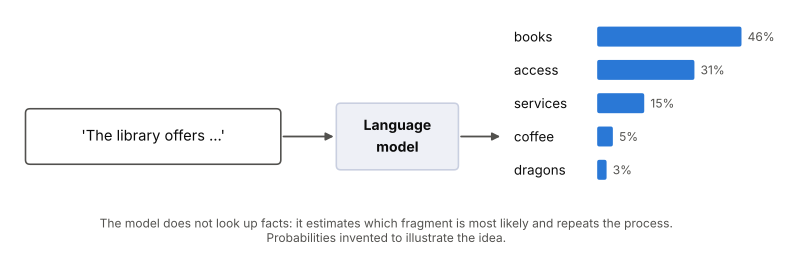
How a language model generates text: it estimates the probability of each possible continuation and chooses one; then it repeats
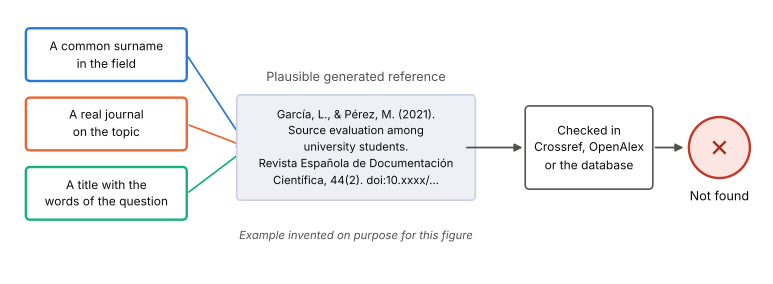
How a fabricated reference arises
Innovative applications and technical challenges
| Challenge | What it involves |
|---|---|
| Truthfulness | Reducing hallucinations and grounding answers in verifiable sources |
| Currency | Incorporating information after training without retraining the whole model |
| Explainability | Understanding why the model produces a particular answer |
| Bias | Detecting and mitigating biases inherited from the data |
| Efficiency | Reducing the energy consumption and cost of training and using the models |
| Evaluation | Reliably measuring what they can do and where they fail |
| Detection | Distinguishing generated content from human content, which cannot be done reliably today |
Responsible uses for study
| Use | Risk | Good practice |
|---|---|---|
| Asking it to explain a concept | Medium | Compare with a textbook or a reliable source |
| Generating ideas or an initial outline | Low-medium | Use it as a starting point, not as a result |
| Checking the spelling and clarity of your text | Low | Review each change; the text is still yours |
| Searching for literature | High | Verify every reference in a database |
| Summarising a document | Medium | Read the original; the summary may omit or invent |
| Writing the assignment for you | Unacceptable | It is presenting someone else’s work as your own (Unit 3) |
Further resources
| Resource | What it is for |
|---|---|
| Crossref | Checking DOIs and metadata |
| OpenAlex | Checking whether an article exists |
| UNESCO – Guidance for generative AI in education and research (Miao & Holmes, 2023) | International guidance |
Required reading
Walters, W. H.; Wilder, E. I. (2023). Fabrication and errors in the bibliographic citations generated by ChatGPT. Scientific Reports, 13, 14045.
For discussion
- A language model generates text by predicting the most likely fragment that follows a given text. (true or false?)
- An AI answer that looks correct but is false or invented is called a ______
- If an AI gives a reference with a DOI, authors and journal, the reference exists. (true or false?)
- Which of these uses is riskiest? Checking the spelling of your text / Asking for initial ideas / Searching for literature without verifying it
For discussion
- If 3 of 12 references generated by an AI are fabricated, the proportion fabricated is 0.12 / 0.25 / 0.33 / 3
- Retrieval-augmented generation completely eliminates errors. (true or false?)
- Why can a language model fabricate a plausible reference?
- What a language model knows depends on its ______ data
For discussion
- Detectors exist today that distinguish AI-generated text from human text with complete reliability. (true or false?)
- To check whether a reference given by an AI exists, the most reliable approach is to ask the same AI whether it exists / look it up by its DOI or title in Crossref, OpenAlex or a database / check that the format looks correct
Digital Skills for Information Use