Units 8 and 9. Generative artificial intelligence: ethics, authorship and regulation
Pablo Sánchez-Núñez
Units 8 and 9. Generative artificial intelligence: ethics, authorship and regulation
Digital Skills for Information Use
https://pablosancheznunez.com/digital-skills-information/06-ai-ethics.html
Objectives
- Analyse the ethical principles of generative AI: consent, privacy and informational self-determination.
- Understand responsibility and authorship in the use of AI.
- Declare the use of AI transparently in academic work.
- Know the European regulatory framework and the ethical principles of AI.
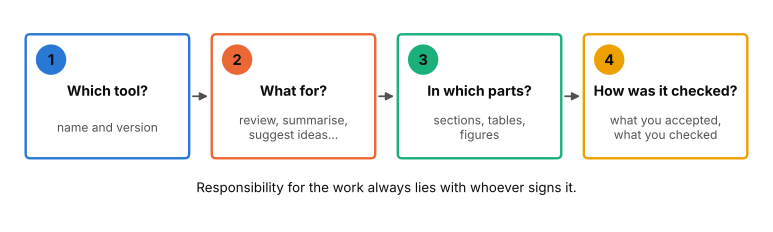
From use to statement: which tool, what for, in which parts and how it was checked
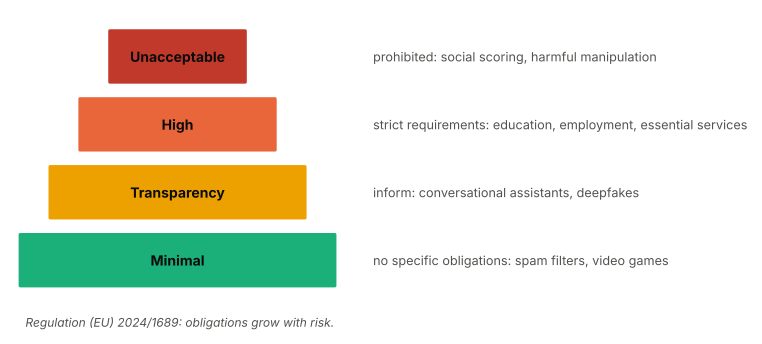
The four risk levels of the EU AI Act
Ethical principles of AI
| Principle | What it means |
|---|---|
| Beneficence | Promoting the well-being of people and the planet |
| Non-maleficence | Avoiding harm: privacy, security, misuse |
| Autonomy | People keep the power to decide |
| Justice | Sharing benefits, avoiding discrimination |
| Explicability | Being able to understand how it works and who is accountable |
The European regulatory framework
| Risk level | Examples | Consequence |
|---|---|---|
| Unacceptable | Social scoring, manipulation causing harm | Prohibited |
| High | AI in education to assess or admit students, in employment, in essential services | Strict requirements: risk management, quality data, human oversight |
| Transparency | Conversational assistants, generated content (deepfakes) | Informing people that they are interacting with an AI or that the content is artificial |
| Minimal | Spam filters, video games | No specific obligations |
Example 3 · Which risk category? (EU AI Act)
| Category | Examples | Consequence |
|---|---|---|
| Unacceptable risk | Social scoring of people; manipulation that causes harm | Prohibited |
| High risk | AI to decide access to education or to assess students; recruitment | Strict requirements: risk management, data, human oversight, transparency |
| Transparency risk | Chatbots; generated or manipulated content (deepfakes) | Informing people that they are interacting with an AI or that the content is artificial |
| Minimal risk | Spam filters, video games | No specific obligations |
Required reading
Floridi, L.; Cowls, J. (2019). A unified framework of five principles for AI in society. Harvard Data Science Review, 1(1).
For discussion
- The principle that Floridi and Cowls add to the four from bioethics is ______
- An AI can be listed as co-author of a scientific article if it has written much of the text. (true or false?)
- Under the EU AI Act, an AI system used to assess students is minimal / transparency / high / unacceptable risk
- Social scoring of people is allowed with oversight / prohibited / subject only to transparency
For discussion
- It is good practice to enter classmates’ personal data into an AI assistant so it can write a group assignment. (true or false?)
- The EU AI Act follows an approach based on model size / risk / economic sector
- What should an AI use statement include?
- Each person’s right to decide on the use of their personal data is called informational ______
For discussion
- Informing people that content has been generated by AI is an obligation of the minimal / transparency / unacceptable risk level
- If you declare your use of AI, you are no longer responsible for any errors in the work. (true or false?)
Digital Skills for Information Use