Chapter 1. The architecture of a research article
Pablo Sánchez-Núñez
Chapter 1. The architecture of a research article
Scientific English for Researchers
https://pablosancheznunez.com/scientific-english/01-structure.html
Objectives
- Describe the IMRaD structure and the purpose of each section.
- Identify the rhetorical moves of introductions and abstracts.
- Plan a paper around one central contribution.
The hourglass shape of a research article: broad context, a narrow question and methods, and a widening discussion
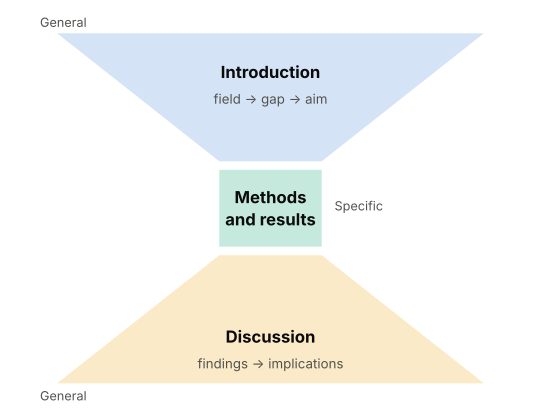
IMRaD
| Section | Question it answers | Typical verb tense |
|---|---|---|
| Introduction | Why does this matter, what is unknown, what did you do? | Present (known facts), past (previous studies), present (aim) |
| Methods | How exactly did you do it? | Past, often passive or “we” |
| Results | What did you find? | Past |
| Discussion | What does it mean, how does it fit, what are the limits? | Present for interpretation, past for your findings |
Required reading
Mensh, B.; Kording, K. (2017). Ten simple rules for structuring papers. PLOS Computational Biology, 13(9), e1005619.
For discussion
- According to @mensh2017, a paper should focus on as many contributions as possible / a single central contribution / the methods
- In the CARS model, showing a gap in the literature is “establishing a ______”
- The Methods section is usually written in the past tense. (true or false?)
- A good abstract should include the main results with numbers. (true or false?)
For discussion
- The scheme recommended for papers, sections and paragraphs is context-content-______
- “Results are discussed” is an informative final sentence for an abstract. (true or false?)
- CARS stands for Create a Research ______
- Who is the “naive human reader”?
Challenge for chapter 1 · Map and rewrite
- Choose a recent article in your field and label every sentence of its introduction with a CARS move.
- Write the central contribution of your current research in one sentence and turn it into a title.
- Write a 200-word structured abstract for your research, with numbers in the results.
Scientific English for Researchers