Chapter 1. The architecture of a research article
- Describe the IMRaD structure and the purpose of each section.
- Identify the rhetorical moves of introductions and abstracts.
- Plan a paper around one central contribution.
Required reading
Mensh, B.; Kording, K. (2017). Ten simple rules for structuring papers. PLOS Computational Biology, 13(9), e1005619.
1. One paper, one message
Mensh & Kording (2017) start with the most important rule: focus your paper on a single central contribution, which you can state in the title. Everything else serves that message. If you cannot write it in one sentence, the paper is not ready to be written.
They also recommend writing for the naive human reader: someone intelligent but outside your sub-field, who reads quickly and remembers little. Short sentences, defined terms and a logical flow help experts too.
2. IMRaD
| Section | Question it answers | Typical verb tense |
|---|---|---|
| Introduction | Why does this matter, what is unknown, what did you do? | Present (known facts), past (previous studies), present (aim) |
| Methods | How exactly did you do it? | Past, often passive or “we” |
| Results | What did you find? | Past |
| Discussion | What does it mean, how does it fit, what are the limits? | Present for interpretation, past for your findings |
Mensh and Kording suggest a context-content-conclusion scheme at every level: the paper, each section and each paragraph start by giving context, present the content and end with a conclusion. The first sentence of a paragraph should announce its message; the last should close it.
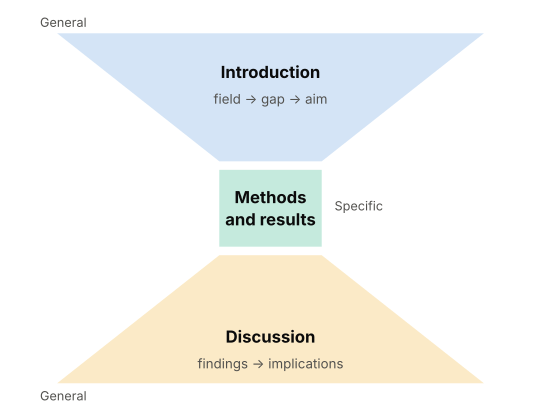
3. The introduction: Swales’s CARS model
John Swales’s analysis of introductions, the CARS model (Create a Research Space), describes three rhetorical moves:
- Establish a territory: show that the topic is important and summarise what is known.
- Establish a niche: show a gap, a problem, a contradiction or an unanswered question.
- Occupy the niche: state your aim, what you did and (often) what you found.
Example:
Doctoral attrition rates exceed 30% in many countries (territory). However, most studies rely on cross-sectional surveys, and little is known about how supervision changes over time (niche). Here, we followed 1,200 doctoral students for five years to examine… (occupy).
4. The abstract
Many journals ask for a structured abstract (Background, Methods, Results, Conclusions). Even when they do not, a good abstract follows the same moves in 150-250 words: context and gap, aim, methods, main results with numbers, and the main conclusion. Avoid references, undefined abbreviations and vague promises such as “results are discussed”.
Worked example
Graded exercises
Basic. Which CARS move is missing from this introduction: “Open data is important. Here, we survey 500 researchers about their data-sharing practices.”?
Move 2, establishing a niche: there is no gap or problem that justifies the survey (for example, “However, little is known about…”).
Advanced. Rewrite the abstract of one of your papers as a structured abstract of no more than 250 words, with numbers in the results.
Check that each part answers its question (why, what, how, what was found, so what) and that the results include effect sizes or key figures, not only directions.
Activities
Esta actividad necesita JavaScript.
Esta actividad necesita JavaScript.
Esta actividad necesita JavaScript.
Assignment
Self-assessment
Answer all the questions and press Show answers. It does not count towards your grade.
- According to Mensh & Kording (2017), a paper should focus on
- In the CARS model, showing a gap in the literature is “establishing a ”
- The Methods section is usually written in the past tense.
- A good abstract should include the main results with numbers.
- The scheme recommended for papers, sections and paragraphs is context-content-
- “Results are discussed” is an informative final sentence for an abstract.
- CARS stands for Create a Research
- Who is the “naive human reader”?
- One message, stated in the title.
- Move 2.
- You report what you did.
- Concrete findings.
- At every level.
- It says nothing.
- John Swales.
- Writing for them helps everyone.