Unit 1. Introduction. Information sources
- Recognise information overload and the different types of false information.
- Use digital information critically, reflectively and proactively.
- Identify, select and evaluate information sources, including social media as a scientific source.
Required reading
Metzger, M. J.; Flanagin, A. J. (2013). Credibility and trust of information in online environments: The use of cognitive heuristics. Journal of Pragmatics, 59, 210-220.
Further reading
1. Information, overload and false information
Accessing information has never been so easy, and knowing which information is reliable has never been so hard. Bawden & Robinson (2009) describe the “dark side” of information: information overload (more information than can be processed), the anxiety it causes and other paradoxical effects, such as feeling less informed the more information you receive.
When it comes to false information, it is useful to distinguish:
| Type | What it is | Example |
|---|---|---|
| Misinformation | False, but shared without intending to deceive | Forwarding an ineffective home remedy believing it works |
| Disinformation | False and created or spread to deceive | A campaign with invented data to influence an election |
| Malinformation | True, but used to cause harm | Publishing someone’s real personal data |
Pennycook & Rand (2021) show that many people share false information not so much because of ideological bias as because of inattention: they do not stop to think whether it is true before sharing it. A short pause improves judgement.
2. Critical, reflective and proactive use
Metzger & Flanagin (2013) explain that, online, people do not assess credibility systematically but with mental shortcuts (heuristics): reputation (a well-known brand seems reliable), endorsement by others (many reviews or likes), consistency (what is repeated on several sites), expectancy violation (a sloppy design or errors make us suspicious) and persuasive intent (if it looks like they want to sell us something, we distrust it). These shortcuts are useful, but they can be exploited: a fake website can imitate a well-known brand and reviews can be bought.
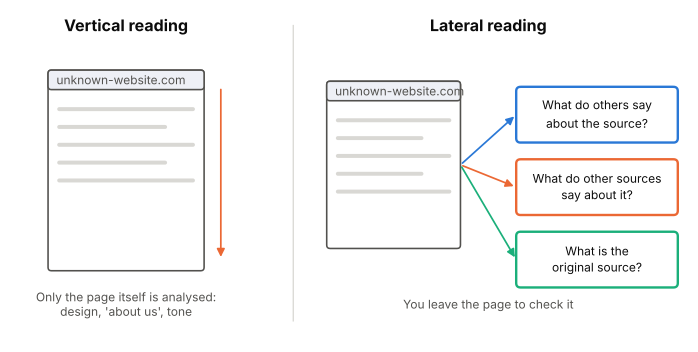
Using information critically means replacing the shortcut with a check when it matters. For this, lateral reading works better than vertical reading: instead of analysing the page in depth (it may be designed to look reliable), you open other tabs to find out what others say about that source and that claim. This is what professional fact-checkers do.
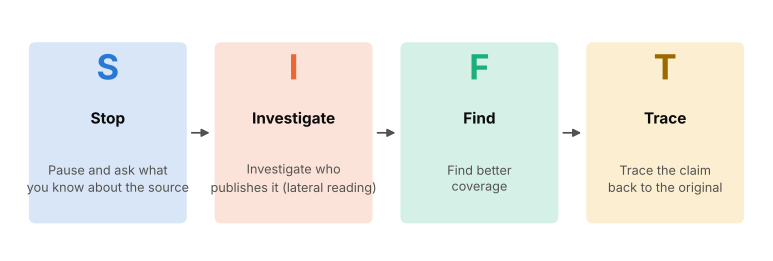
The SIFT method, proposed by Mike Caulfield, sums up lateral reading in four steps:
- Stop: before reading or sharing, ask yourself whether you know the source.
- Investigate the source: who is behind it and what interests do they have?
- Find better coverage: what do other reliable sources say about the same thing?
- Trace claims: find the primary source of the claim, quote or image.
3. Identifying, selecting and evaluating sources
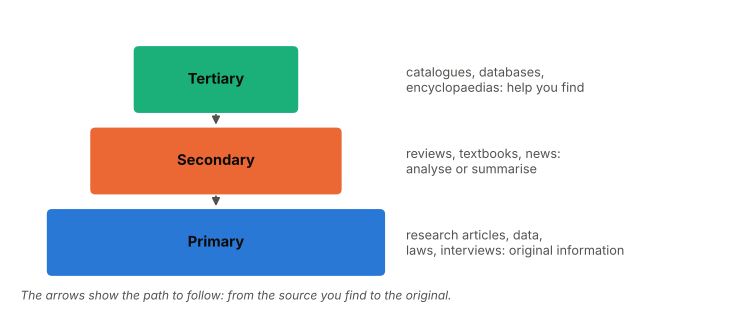
Sources are usually classified as primary (original information: a research article, a dataset, a law, an interview), secondary (they analyse or summarise primary sources: a review, a textbook, a news story about a study) and tertiary (they help you find the others: catalogues, databases, encyclopaedias).
To select them, the key question is what do I need: a definition, up-to-date data, the scientific evidence on a topic, the legislation in force. To evaluate them, a useful checklist is:
| Criterion | Questions |
|---|---|
| Authorship | Who signs it? Do they know the subject? Is there a responsible organisation? |
| Purpose | Does it inform, give an opinion, sell, persuade? |
| Currency | When was it published or updated? Does the date matter for your topic? |
| Accuracy | Does it cite its sources? Can it be checked? Does it agree with other reliable sources? |
| Review | Has it passed peer review, professional editing or no check at all? |
5. Disinformation and libraries: the IFLA infographic
In 2017 the International Federation of Library Associations and Institutions (IFLA) published the infographic How to Spot Fake News, adapted from a 2016 FactCheck.org article. It starts from one idea: critical thinking is a key skill of media and information literacy, and libraries should teach and defend it. IFLA offers it for download, printing, translation and sharing in libraries, communities and social media.
| Step | What the infographic proposes | In practice |
|---|---|---|
| 1. Consider the source | Investigate the website, its mission and its contact information | Who publishes it? Is there a real “About us” and contact? |
| 2. Read beyond | A striking headline seeks attention: what is the whole story? | Read the whole text, not just the headline or thumbnail |
| 3. Check the author | A quick search: are they credible? Are they real? | Look for their professional profile or ORCID |
| 4. Supporting sources | Click the links and check that the information supports the story | Trace the claim back to the original study or document |
| 5. Check the date | Reposting old news does not make it relevant to current events | Look at the date of publication and of the data |
| 6. Is it a joke? | If it is too outlandish, it may be satire | Check whether the outlet is satirical |
| 7. Check your biases | Your own beliefs can affect your judgement | Be more suspicious of what confirms what you already thought |
| 8. Ask the experts | Ask a librarian or consult a fact-checking site | University libraries, fact-checkers such as Full Fact or Maldita.es |
IFLA’s eight steps and SIFT’s four moves (worked example 1) complement each other: SIFT organises the process into four quick moves based on lateral reading, and IFLA breaks down what to check in each source. Step 7, checking your own biases, is perhaps the hardest: we tend to accept without checking whatever matches our ideas (confirmation bias).
Worked examples
A headline says: “Study proves that sleeping less than six hours doubles the risk of failing”. The SIFT method (Mike Caulfield) proposes four quick moves:
- Stop: before sharing or believing it, ask yourself what you know about the source and how the headline makes you feel. A bold, emotional headline calls for more care.
- Investigate the source: open another tab and find out who publishes the story (an outlet with a science desk, a commercial blog?). This is lateral reading: you evaluate a source by reading what others say about it, not what it says about itself.
- Find better coverage: look for the topic in other reliable sources; if it is important, other outlets or agencies will have reported it.
- Trace claims: find the original study (title, journal, DOI) and compare: is it an observational study? With how many people? Does it say “doubles” or “is associated with”?
Typical result: the original study found an association in a survey of students at one university; the headline turned it into a general causal relationship. The correct claim would be: “In a survey, students who slept less than six hours failed more subjects”.
Graded exercises
Basic. Classify these sources as primary, secondary or tertiary: an article presenting an experiment; an encyclopaedia; a systematic review.
Experiment: primary (it presents new data). Systematic review: secondary (it synthesises primary studies). Encyclopaedia: tertiary (it summarises and points to other sources).
Intermediate. Apply the four SIFT moves to a science news story from this week and write five lines on what changes between the headline and the original study.
Check at least: who publishes it, whether there is other coverage, the design of the original study (experimental or observational), the sample size and whether the verb in the headline (“proves”, “causes”) matches what the study says (“is associated with”, “suggests”).
Advanced. Choose a journal in your field that you do not know and write a short report on its reliability using the five criteria in example 2 and the sources you consulted.
A good report cites verifiable evidence (a link to DOAJ or the database, editorial board names that have been checked, the published review and fee policy) and distinguishes between what has been checked and what could not be verified.
Activities
Esta actividad necesita JavaScript.
Esta actividad necesita JavaScript.
Esta actividad necesita JavaScript.
Esta actividad necesita JavaScript.
Esta actividad necesita JavaScript.
Esta actividad necesita JavaScript.
Practice
Choose a striking claim you have seen on social media this week. Apply the four SIFT steps and note how long it took you and what you found at each step. Compare it with what you would have concluded by reading only the post.
Assessed challenge
Self-assessment
Answer all the questions and press Show answers: correct answers turn green, wrong ones red, and you will see your score. You can change your answers and check again. It does not count towards your mark.
- Forwarding an ineffective home remedy believing it works is a case of
- According to Pennycook and Rand, many people share fake news mainly through a lack of
- Lateral reading consists of analysing the page itself in depth before leaving it.
- The last SIFT step, tracing to the original, looks for the source
- Which heuristic do we use when we trust a website because it has many positive reviews?
- A review article summarising many studies is a source
- What do social media mentions of an article measure?
- Spreading someone’s real personal data to harm them is
- A law published in the Spanish Official State Gazette (BOE) is a source
- A preprint has already passed peer review.
- It is false, but without intent to deceive.
- A pause to think improves judgement.
- That is vertical reading; lateral reading leaves the page to check it.
- The original source of the claim.
- Endorsement by others: reviews, likes, recommendations.
- It summarises and analyses primary sources.
- Altmetrics measure attention, not quality or truth.
- It is true, but used to cause harm.
- It is the original text of the law.
- It is a version before review.
Further resources
| Resource | What it is for |
|---|---|
| IFLA – How to Spot Fake News (2017) | Eight-step infographic for spotting fake news, in many languages |
| Caulfield, M. – SIFT (The four moves) | The SIFT method explained by its author |
| ACRL – Framework for Information Literacy | Framework for information literacy |
| Full Fact, Maldita.es and Newtral | Fact-checkers in the UK and Spain |
| IFCN – Code of principles | International fact-checking network |
| The information literacy user’s guide | Open textbook from the core bibliography |
4. Social media as a source of scientific information
Social media is increasingly used to spread and discuss science. Sugimoto et al. (2017) review how researchers use it and how these mentions are measured (altmetrics). For a student, social media can help you discover recent research and debates, but it is not the source: you need to get to the original article. Remember that: