Units 8 and 9. Generative artificial intelligence: ethics, authorship and regulation
- Analyse the ethical principles of generative AI: consent, privacy and informational self-determination.
- Understand responsibility and authorship in the use of AI.
- Declare the use of AI transparently in academic work.
- Know the European regulatory framework and the ethical principles of AI.
Required reading
Floridi, L.; Cowls, J. (2019). A unified framework of five principles for AI in society. Harvard Data Science Review, 1(1).
Further reading
- Regulation (EU) 2024/1689 laying down harmonised rules on artificial intelligence. Official Journal of the European Union.
- Bender et al. (2021) — Environmental costs and biases of large models.
1. Ethical principles of AI
Floridi & Cowls (2019) compared the main international statements on AI ethics and summarised them in five principles:
| Principle | What it means |
|---|---|
| Beneficence | Promoting the well-being of people and the planet |
| Non-maleficence | Avoiding harm: privacy, security, misuse |
| Autonomy | People keep the power to decide |
| Justice | Sharing benefits, avoiding discrimination |
| Explicability | Being able to understand how it works and who is accountable |
The first four come from bioethics; the fifth is specific to AI and makes the others possible.
2. Ethical risks in everyday use
- Bias: models reproduce the biases in their training data (gender, origin, language). An answer can look neutral and be biased underneath.
- Consent, privacy and informational self-determination: informational self-determination is each person’s right to decide what is done with their personal data; in Spain, the Constitutional Court recognises it as the fundamental right to data protection. Models are often trained on data collected from the internet without their authors’ consent, and what you write into an assistant may be stored and, depending on the service, used to train models. Do not enter your own or other people’s personal data, or confidential documents, and check the service’s privacy settings.
- Authorship and intellectual property: a generated text is not yours; moreover, models are trained on protected works, an open legal debate.
- Dependence and learning: delegating to AI what the course wants you to learn prevents you from learning it.
- Environmental cost: training and using large models consumes a lot of energy and water (Bender, Gebru, et al., 2021).
3. Responsibility, authorship and transparency
In academic work, the general rule is transparency: if you use AI, say so, explain what for and take responsibility for the result. Scientific publishers and COPE (Committee on Publication Ethics) agree that an AI cannot be an author, because it cannot take responsibility for the work.
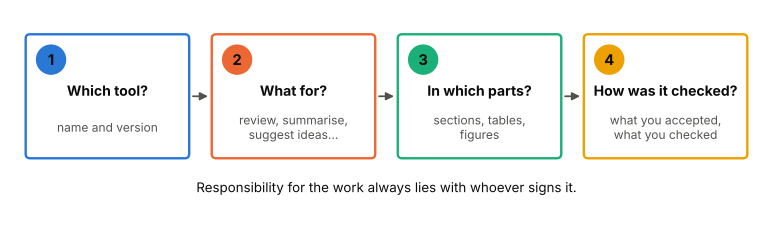
A useful statement says which tool (and version), what for it was used, in which parts and how the result was checked. For example:
AI use statement: I used [tool, version] to check the spelling and clarity of sections 2 and 3, and to suggest synonyms in the table of search terms. I reviewed and accepted or rejected each suggestion. The searches, the selection of documents and the conclusions are my own. I did not enter any personal data.
If the AI influences the content, APA also recommends citing it in the text and in the references, giving the prompt used in an appendix or in the text.
4. The European regulatory framework
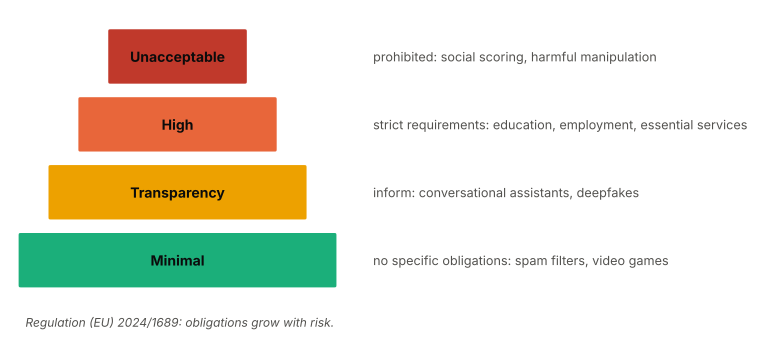
Regulation (EU) 2024/1689 on Artificial Intelligence (AI Act) is the first comprehensive law on AI. It follows a risk-based approach:
| Risk level | Examples | Consequence |
|---|---|---|
| Unacceptable | Social scoring, manipulation causing harm | Prohibited |
| High | AI in education to assess or admit students, in employment, in essential services | Strict requirements: risk management, quality data, human oversight |
| Transparency | Conversational assistants, generated content (deepfakes) | Informing people that they are interacting with an AI or that the content is artificial |
| Minimal | Spam filters, video games | No specific obligations |
The regulation also covers general-purpose AI models (the ones behind assistants) and requires those who deploy AI systems to ensure that their staff have a sufficient level of AI literacy. Its obligations apply in stages from 2025. Other rules, such as the General Data Protection Regulation, continue to apply to AI.
Worked examples
Graded exercises
Basic. Who is responsible for the content of work done with the help of an AI?
The author. The AI cannot be an author or take responsibility; whoever signs the work answers for its accuracy and originality.
Intermediate. Classify according to the categories of the Regulation: (a) a student support chatbot; (b) a system that decides admission to a master’s programme; (c) a spell checker.
- Transparency risk: it must say that it is an AI. (b) High risk: it affects access to education. (c) Minimal risk.
Advanced. Analyse a real or realistic case of AI use in your academic environment with the chapter’s ethical principles and propose a short policy for your course or group.
A good policy says which uses are allowed and which are not, how they are declared, what happens to personal data and how the work is verified. It must be consistent with the university’s rules.
Activities
Esta actividad necesita JavaScript.
Esta actividad necesita JavaScript.
Esta actividad necesita JavaScript.
Practice
Find UC3M’s or your course’s AI use policy and the AI policy of a journal in your field. Compare them: what do they allow, what do they prohibit and what do they ask you to declare?
Assessed challenge
Self-assessment
Answer all the questions and press Show answers: correct answers turn green, wrong ones red, and you will see your score. You can change your answers and check again. It does not count towards your mark.
- The principle that Floridi and Cowls add to the four from bioethics is
- An AI can be listed as co-author of a scientific article if it has written much of the text.
- Under the EU AI Act, an AI system used to assess students is risk
- Social scoring of people is
- It is good practice to enter classmates’ personal data into an AI assistant so it can write a group assignment.
- The EU AI Act follows an approach based on
- What should an AI use statement include?
- Each person’s right to decide on the use of their personal data is called informational
- Informing people that content has been generated by AI is an obligation of the risk level
- If you declare your use of AI, you are no longer responsible for any errors in the work.
- It makes the other four principles possible.
- Authorship requires responsibility, and an AI cannot take it on.
- Education and the assessment of students are high-risk areas.
- It is a prohibited practice.
- It puts other people’s privacy at risk.
- Obligations grow with the risk.
- This way readers know what is yours and what is not.
- The basis of the right to data protection.
- It affects assistants and synthetic content.
- Responsibility remains with whoever signs.
Further resources
| Resource | What it is for |
|---|---|
| Regulation (EU) 2024/1689 | Official text of the AI Act |
| COPE – Authorship and AI tools | Position on AI and authorship |
| APA Style – How to cite ChatGPT | Citing AI-generated content |
| UNESCO – Recommendation on the Ethics of AI | International ethical framework |