Unit 3. Ethical use of information and plagiarism
NoteObjectives
- Know the basics of intellectual property and the right of quotation.
- Recognise the different types of plagiarism.
- Produce academic work without plagiarism: quote, paraphrase and summarise correctly.
Required reading
Pecorari, D.; Petrić, B. (2014). Plagiarism in second-language writing. Language Teaching, 47(3), 269-302.
Further reading
- Royal Legislative Decree 1/1996, Spanish Intellectual Property Act (in Spanish). Consolidated text; article 32 regulates quotations.
- Creative Commons (n.d.)
1. Information ethics
Using information ethically means acknowledging other people’s work, respecting their rights and not deceiving the readers of your own work. At university, this commitment is called academic integrity: honesty, trust, fairness, respect and responsibility in study and research.
2. Intellectual property
In Spain, the Intellectual Property Act (Royal Legislative Decree 1/1996) protects original creations (texts, images, music, software…) from the moment they are created, without needing to register them. It distinguishes:
- Moral rights: recognition of authorship and integrity of the work. They cannot be waived.
- Economic rights (exploitation rights): reproduction, distribution, public communication and transformation. As a general rule, they last for the author’s whole life and 70 years after their death; after that the work enters the public domain.
The right of quotation (art. 32) allows you to include fragments of other people’s works without asking permission when it is done as a quotation or for analysis, commentary or critical judgement, for teaching or research purposes, to the extent justified by that purpose, and stating the source and the author’s name.
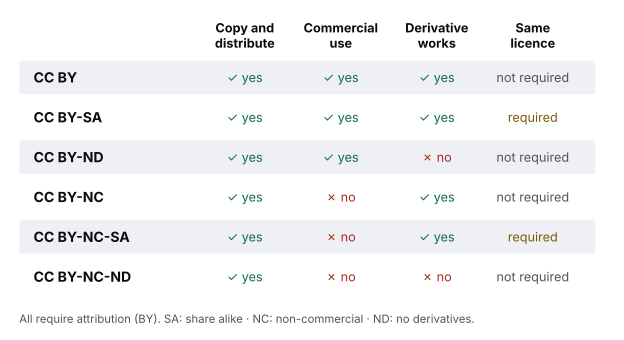
Creative Commons licences allow authors to authorise certain uses in advance. They combine four conditions: BY (attribution, present in all of them), SA (share alike), NC (non-commercial) and ND (no derivatives). This book, for example, is licensed CC BY 4.0.
3. What plagiarism is
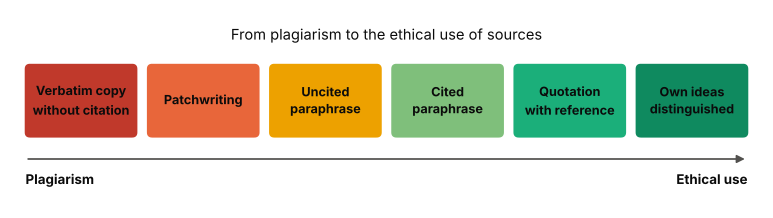
Plagiarism is presenting someone else’s work, ideas or words as your own without acknowledging them. Pecorari & Petrić (2014) distinguish intentional plagiarism from the kind that comes from not knowing how to write with sources, especially when learning to write in another language or in a new academic genre. Both are plagiarism, but the second is prevented by learning.
| Type | What it is |
|---|---|
| Verbatim copying | Copying text without quotation marks or citation |
| Patchwriting | Copying while changing a few words or their order, keeping the structure of the original |
| Uncited paraphrase | Rewording someone else’s ideas well, but without citing the source |
| Plagiarism of ideas | Using someone else’s argument, data or structure without acknowledging it |
| Self-plagiarism | Reusing your own work that has already been assessed or published without saying so |
| Work done by others | Submitting work commissioned from someone else or generated by an AI as if it were your own |
In this course, plagiarism or copying in any activity means losing the mark for that activity.
4. How to write with sources without plagiarising
- Quotation: the exact words, in quotation marks, with the reference (and the page, if there is one). For sentences that matter because of their exact wording.
- Paraphrase: the author’s idea in your own words and your own structure, with the reference. Tip: read, close the text, write what you have understood and then check that it is not too similar to the original.
- Summary: the main ideas of a long text, more briefly, with the reference.
- Your own ideas: they do not need a citation, but they must be clearly distinguished from other people’s.
- Common knowledge (widely known, easily checked facts): no citation needed. When in doubt, cite.
R practice: how software detects overlaps
Similarity-checking software compares fragments of consecutive words. A simple approach is to split texts into groups of three words (trigrams) and calculate what proportion they share (Jaccard similarity: shared / total distinct):
Exercise 3.1
Calculate the similarity between the original and a verbatim copy (the same text). What value do you expect?
Compare the original with the object copy.
copy <- original
similarity(original, copy)
1: all the trigrams match. Patchwriting gives an intermediate value and a good paraphrase, almost 0. That is why this software detects copying well, patchwriting less well and paraphrase or translation hardly at all: it does not replace the judgement of the marker.
Lab: what a similarity checker sees
Lab · runs in your browser, without sending the text anywhere
Paste an original text and your version. The lab splits both into groups of three words (trigrams), calculates what proportion they share (Jaccard similarity) and highlights the words in your version that belong to copied trigrams. Try a verbatim copy, a patchwriting and a real paraphrase.
Worked examples
NoteExample 1 · Paraphrasing step by step
Original text (invented for this example): “Peer review, despite its limitations, remains the main quality-control mechanism of the scientific literature, although its effectiveness in detecting errors has been questioned by numerous studies” (Pérez, 2021, p. 14).
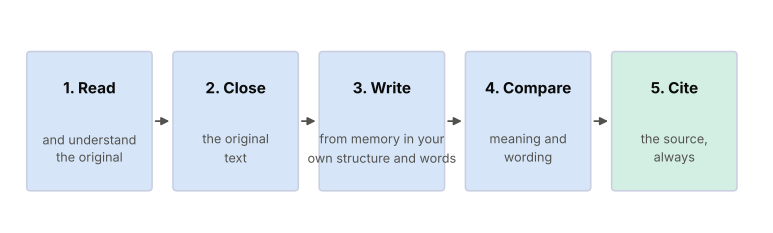
- Read and understand the whole text; then close the original.
- Write from memory the idea in your own words and structure: Although it is debated whether it catches errors well, evaluation by specialists continues to be the central tool for guaranteeing the quality of what is published in science (Pérez, 2021).
- Compare with the original: have you changed the structure and vocabulary, not just a few synonyms? Do you keep the meaning?
- Cite the source even though you have paraphrased.
Bad example (patchwriting): Peer review, in spite of its limits, continues to be the principal quality-control mechanism of the scientific literature. It changes two words and keeps the structure: it is plagiarism even if cited, because it is presented as your own wording.
Graded exercises
Basic. Is it plagiarism to copy a sentence in quotation marks, with its reference and page?
No: it is a correct quotation. It should be used sparingly and for sentences whose exact wording matters.
Intermediate. Paraphrase this invented text and cite it: “Reference managers reduce formatting errors and save time, but they require checking the imported metadata” (Ruiz, 2022, p. 3).
Example: Tools such as Zotero make it easier to format a bibliography and avoid mistakes, as long as the data they import automatically are checked (Ruiz, 2022). Other wordings are valid if they change structure and vocabulary and keep the idea.
Advanced. Take a paragraph from your own work, run it through the chapter’s similarity lab with a source you used, and rewrite the parts with long overlaps. Explain what changes you made.
Overlaps of a few words (technical terms, names) are not a problem; long sequences with identical structure are. The rewriting should start from understanding, not from swapping synonyms.
Activities
Esta actividad necesita JavaScript.
Esta actividad necesita JavaScript.
Assessed challenge
Self-assessment
Answer all the questions and press Show answers: correct answers turn green, wrong ones red, and you will see your score. You can change your answers and check again. It does not count towards your mark.
- A well-written paraphrase does not need a citation because it uses your own words.
- Copying while changing some words but keeping the structure of the original is called
- An author’s moral rights cannot be waived.
- In a Creative Commons licence, the condition that prevents commercial use is
- Under the Spanish Intellectual Property Act, economic rights generally last for the author’s life plus
- Submitting work generated by an AI as your own is a form of plagiarism.
- Why is similarity-checking software not enough to decide whether there is plagiarism?
- Reusing your own already-assessed work without saying so is called
- The Creative Commons condition present in all licences is
- Common-knowledge facts, widely known and easy to check, do not need a citation.
- The idea still belongs to someone else: you must cite it even if the words are yours.
- Changing words without changing the structure.
- Recognition of authorship cannot be transferred.
- NC, non-commercial.
- 70 years after the author’s death, as a general rule.
- It is presenting as your own work that is not.
- It measures text overlaps, not whether the source is used correctly.
- It is also a form of plagiarism.
- Attribution.
- When in doubt, it is better to cite.
Further resources
| Resource | What it is for |
|---|---|
| Spanish Intellectual Property Act (BOE) | Consolidated text (in Spanish) |
| Creative Commons – Licenses | Choosing and understanding a licence |
| The information literacy user’s guide, chapter on ethics | Open textbook |
Creative Commons. (n.d.). Licenses. What each licence allows. Retrieved https://creativecommons.org/licenses/
Pecorari, D., & Petrić, B. (2014). Plagiarism in second-language writing. Language Teaching, 47(3), 269–302. https://doi.org/10.1017/S0261444814000056