Units 4 and 5. References
NoteObjectives
- Create and manage references in academic work.
- Apply a citation style and order the references.
- Know similarity-checking tools and their limits.
Required reading
Gilmour, R.; Cobus-Kuo, L. (2011). Reference management software: A comparative analysis of four products. Issues in Science and Technology Librarianship, 66.
Further reading
1. Why cite
Citing serves to acknowledge other people’s work, show what your statements are based on, allow readers to find the sources and distinguish your ideas from those of others. Academic work has two related elements:
- The in-text citation: a short marker where you use the source, such as (Bates, 1989) or [3].
- The reference: the full description of the source in the final list.
2. Citation styles
A style sets which details are included, in what order and with what punctuation. There are two main systems:
| System | In-text citation | Order of the list | Styles |
|---|---|---|---|
| Author-date | (Metzger & Flanagin, 2013) | Alphabetical by surname | APA 7, Harvard, Chicago author-date |
| Numeric | [1] or superscript | In order of appearance | Vancouver, IEEE, numeric ISO 690 |
APA 7th edition is widely used in this degree. What matters is to choose a style, apply it consistently and follow the one required by each lecturer or journal.
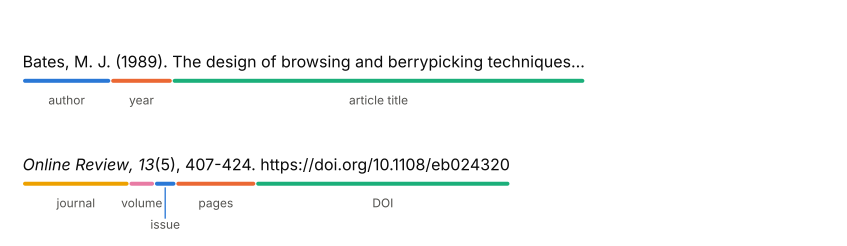
3. References for the most common document types (APA 7)
| Type | Pattern |
|---|---|
| Journal article | Surname, I. (Year). Title of the article. Journal, volume(issue), pages. https://doi.org/… |
| Book | Surname, I. (Year). Title of the book (ed.). Publisher. |
| Book chapter | Surname, I. (Year). Title of the chapter. In I. Surname (Ed.), Title of the book (pp. x-y). Publisher. |
| Web page | Author or organisation. (Year, Month day). Title. Website. URL |
| Law | Title of the law. Official gazette, number, date. URL |
The DOI (Digital Object Identifier) is a permanent identifier for a digital document. If there is one, include it as a link https://doi.org/…: even if the journal’s website changes, the DOI will still lead to the document.
4. Reference managers
A reference manager stores documents with their details, organises them, inserts citations into the word processor and generates the bibliography in any style. Gilmour & Cobus-Kuo (2011) compared several managers and found that they all make mistakes when generating references (capitalisation, missing data, name formats), so you must always check them. The most widely used are Zotero (free and open source), Mendeley and EndNote.
A recommended workflow:
- Capture the reference from the database or the browser (with the manager’s connector).
- Check and complete the details.
- Organise them in collections and tags.
- Cite from the word processor with the manager’s plug-in.
- Review the final bibliography.
5. Similarity-checking tools
Universities use software that compares assignments with large text databases and flags overlaps. Foltýnek et al. (2020) evaluated many of these tools and concluded that they detect verbatim copying well but struggle with modifications (paraphrase, synonyms, translations), and that none is perfect. The similarity report is an indication, not a verdict: a well-made quotation matches its source and is not plagiarism, and an uncited paraphrase may not match and still be plagiarism.
R practice: building and ordering references
paste0() joins text. With it you can see how a manager builds a reference from its data:
Exercise 4.1
In APA style, the list is ordered alphabetically by the first author’s surname. Sort these references with sort() and write which one comes first.
The function that sorts a vector is sort().
sorted_refs <- sort(refs)
sorted_refs[1]
Bates (1989): “Bat” comes before “Baw”. Managers sort like this, letter by letter.
Lab: from DOI to reference
Lab · live data from Crossref
Type a DOI and the lab asks Crossref for the reference in APA 7, just as a reference manager does. Then check it: look for extra capital letters, missing italics or incomplete data. This is exactly what Gilmour & Cobus-Kuo (2011) found.
Also try: 10.1108/eb024320, 10.1038/s41598-023-41032-5 or the DOI of the Spanish edition of this book, 10.5281/zenodo.24515144 (registered with DataCite, not Crossref).
Worked examples
Graded exercises
Basic. How do you cite in the text a 2023 work by two authors, García and López?
(García & López, 2023) in parentheses, or García and López (2023) in the narrative. With two authors, both are always cited.
Intermediate. Write the APA 7 reference for this dataset: author Marta Ruiz, 2024, “University reading habits survey”, version 1.2, deposited in Zenodo with DOI 10.5281/zenodo.0000000 (fictitious DOI).
Ruiz, M. (2024). University reading habits survey (Version 1.2) [Data set]. Zenodo. https://doi.org/10.5281/zenodo.0000000
Advanced. Import into Zotero ten references on your topic from three different sources, correct their metadata and generate the bibliography in APA 7 and in another style from your field. Note the errors you found.
Typical errors: titles in capitals, corporate authors split as people, chapters imported as books, missing DOI or pages. Noting them helps you always check what a manager imports.
Activities
Esta actividad necesita JavaScript.
Esta actividad necesita JavaScript.
Esta actividad necesita JavaScript.
Assessed challenge
Self-assessment
Answer all the questions and press Show answers: correct answers turn green, wrong ones red, and you will see your score. You can change your answers and check again. It does not count towards your mark.
- In the author-date system, the reference list is ordered
- Vancouver and IEEE are styles of the system
- The permanent identifier of a digital document included as a link in the reference is the
- The references generated by a reference manager are always correct.
- In APA 7, the journal title is written in italics.
- A similarity report of 0% guarantees that the work contains no plagiarism.
- What is the difference between a citation and a reference?
- In APA 7, a work by three or more authors is cited in the text with “et al.” from the first citation.
- Which reference manager is free and open source?
- In a numeric system, the reference list is ordered by
- By the first author’s surname.
- They number citations in order of appearance.
- Digital Object Identifier, permanent even if the website changes.
- Gilmour and Cobus-Kuo found errors in all of them: they must be checked.
- Journal and volume go in italics.
- An uncited paraphrase may not match and still be plagiarism.
- The citation points to the full reference.
- From the first time, unlike APA 6.
- Zotero is free software.
- The number corresponds to the order of citation.
Further resources
| Resource | What it is for |
|---|---|
| APA Style | Official guide to APA 7 style |
| Zotero | Free reference manager |
| Crossref | DOI registration and metadata search |
| Appendix: quick citation guide | APA 7 examples from this book |
American Psychological Association. (n.d.). APA Style. Retrieved https://apastyle.apa.org/
Bates, M. J. (1989). The design of browsing and berrypicking techniques for the online search interface. Online Review, 13(5), 407–424. https://doi.org/10.1108/eb024320
Foltýnek, T. et al. (2020). Testing of support tools for plagiarism detection. International Journal of Educational Technology in Higher Education, 17, 46. https://doi.org/10.1186/s41239-020-00192-4
Gilmour, R., & Cobus-Kuo, L. (2011). Reference management software: A comparative analysis of four products. Issues in Science and Technology Librarianship, 66. https://doi.org/10.5062/F4Z60KZF
Metzger, M. J., & Flanagin, A. J. (2013). Credibility and trust of information in online environments: The use of cognitive heuristics. Journal of Pragmatics, 59, 210–220. https://doi.org/10.1016/j.pragma.2013.07.012